Medieval/Renaissance Garden Party
Elements of 14th-16th century European Garden Design and their Social use
 A group of musical maidens entertains a young man around an artificial pond (or cistern) with a fountain, trees, a latticework enclosure, and a pergola/loggia/arch. From Hypnerotomachia Poliphili, or The Dream of Poliphilius, 1499. (One hopes the lady in the distance is a statue.)

Venus's Garden, Master of the Housebook, last quarter, 15th c.
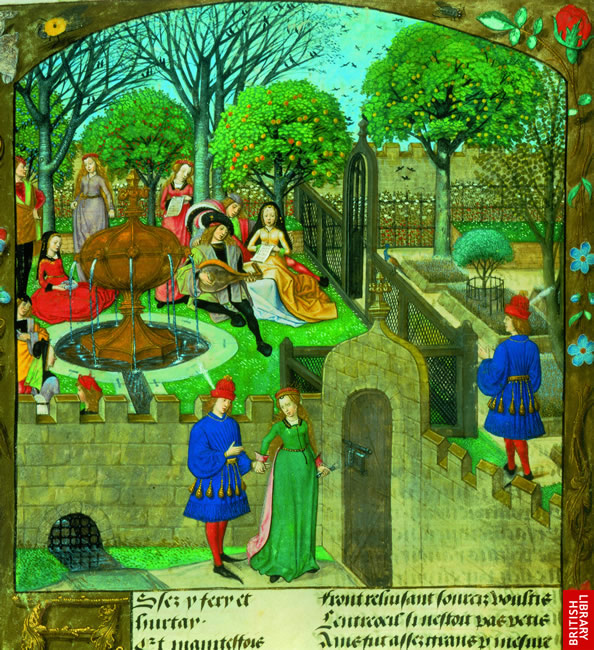 Social uses of gardens depicted in art:
- Walking and exercise paths
- Private conversation
- Music and games
- Picnicing
- Amatory activities
- Sports, including archery and hunting
- Impressing the visitor
Enclosed Gardens and their social use
The defining element of the medieval-to-Renaissance garden was its enclosure. Fences, walls, and hedges, as well as thickly-covered trellises, protected the garden, provided privacy, and mitigated wind and cold.
Fence types:
- Wattle or Wattle and daub: long flexible sticks woven between upright posts, with or without mud chinking (daub). Cheap and easy to renew, seldom depicted in upper-class gardens where socializing took place.
- Stone or Brick: Gardens in monasteries and castles used the external dividing walls as an element. Illustrations of the Roman de la Rose and the Garden of Eden show stone walls similar to manor or castle walls around the garden.
- Posts or Wood palings: similar to picket fence; seen depicted in a number of gardens.
- Lattices and Trellising: both diagonal and non-diagonal. May support climbing vines.
Thomas Hill in his Gardener's Labyrinth discusses the 'forms of the Inclosures ' which he says the ancients invented:
"..First, the skilful and wary Husbandmen in time past, being those of good abilty, built them walls about of Free-stone artly laid, and mortered together, and some did with baked bricke like handled. Others of lesser ability, and of meaner sort, formed them inclosures, with stones handsomely laid one upon another with morter or clay; and some of them couched the broad salt sontesk, with other bigge and large stones (in like order about). . . but very many of the baser and poorer sort, made them fences and wals about, with mudde of the ditch, dung, chaffe, and straws cut short, and wel mixed together. Others there were, which with bigge Canes set upright, by smal poles bound together, so fenced their garden plot, in handsome manner round about. Some also with young Willow trees, set by certaine distances, and the drie black thorne (purchased from the wood) being bound in (between the spaces) so framed their inclosure. . ."
Hedges
Hedges, either made by 'quickset' -- fast growing bushes and small trees, planted close together and then trimmed to shape-- or by planting trees with long, whippy stems, then bending over and interweaving them. Trees were sometimes coppiced, that is, cut off close to the ground, to provide quick, thin growth for this purpose-- extra sprouts could be harvested and used for wattle. Thick hedges are depicted both with rounded, more natural tops, and straight sides and tops.
Hedge and ditch
The combination of a hedge and a ditch, usually with the ditch outside the hedge, was often used in the middle ages to discourage animals from crossing the hedge. Especially characteristic of parkland, where sporting animals had to be kept out. (The use of sudden, deep ditches as dividers is more more characteristic of formal gardens of the 1700s and later, though Evelyn Shirley in 1867 claims that medieval 'deer leaps' in royal deer parks were similar.
Gates and Windows
Obviously a garden without one or more gates is inaccessible. Wooden, metal, and lattice gates are depicted, often varying from the material of the wall they are in. Gates could be made of wood, metalwork, or even framed lattice. Some gardens, inside larger walls, are shown as having no inner doors.
Walls, including lattices, are sometimes shown pierced with window-type openings. Of course, the placement of gardens below the windows of state apartments features in depictions of the stories of Bathsheba and Judith.
Walking elements: Places and Planting
Lawns
In addition to providing soft flooring for walking and sitting, lawns would rest the eyes, as Albertus Magnus says: "For the sight is in now way so pleasantly refreshed as by fine and close grass kept short." As a result, cloisters and areas of study were provided with lawns, especially with covered walkways around them, where the inhabitants could take the fresh air and refresh the sight even in bad weather.
Most writers recommend digging out the original 'waste' plants, killing the seeds in the soil by flooding with boiling water, then laying out the lawn with turves (sod) laid in and pounded well. Another writer recommends mowing them twice a year; lawnmowing would have been done with scythes or primitive shears. Though such sod lawns would have had lower species diversity than a general meadow, they still were expected to include non-grass plants, thus being the 'flowery meads' depicted in embroidery, tapestry, illuminated manuscripts and paintings.
Walking paths
The choice of walking path surface was a vital one, as grass or other dew-collecting surfaces would require the wanderer to have "shooes or boots of some extraordinary goodnesse" in order to walk dry upon them, as Gervase Markham points out in his 1635 English Husbandman. (part 2, page 202)
Paths could be made of grass/dirt, brick, gravel, or stone/paving. As gardens grew larger more elaborate and status-concious in the latter part of the 16th century, these paths were often used in combination with hedges or walls in order to create different 'rooms' in a garden.
Pergolas, Arches and Covered Walks
 Loggias, Pergolas, and Arches appear especially in depictions of Italian gardens. Part of their purpose was to allow visitors to stroll without fear of the sun's heat and/or sunburn. Roses, grapes, gourds (Lagenaria species) are shown trained over these structures.
Covered walks both freestanding and as part of existing buildings (via open colonnades, as at the Cloisters in New York) were popular in monasteries, churches, and hunting park buildings.
Trees
Orchards, or patterned arrangements of sweet-smelling or fruiting trees, were recommended as an excellent place for strolling, both for the inhabitants of cloisters and more worldly garden visitors. Wall-trained or shape-pruned trees could also be incorporated into gardens with rectangular or other layouts.
Orchard trees that give fruit (apples, pears, plums); tender perennials such as bay, orange, pomegranate in the south and later in period, Olives and date palms in the south. Nut trees such as chestnut and almond. Pine and Cypress. Of non-fruiting trees, linden or lime trees were popular in northern Europe; William Stephen in 1180 mentions elms, oaks, ash, and willow "along watercourses and to make shady walks" (says Hobhouse); the Roman de la Rose also mentions fir, and oriental plane trees.
Crescenzi says: "Trees are to be planted in their rows, pears, apples, and palms, and in warm places, lemons. Again mulberries, cherries, plums, and such noble trees as figs, nuts, almonds, quinces, and such-like, each according to their kinds, but spaced twenty feet apart more or less." He also suggests box, broom, cypress, dogwood, laburnum, rosemary, eonymous or spindle and tamarisk.
John Harvey gives this quote from Albertus Magnus:
"There are, however, some places of no great utility or fruitfulness. . . these are what are called pleasure gardens. They are in fact mainly designed for the delight of the two senses, viz. sight and smell. . .[about the lawn] may be planted every sweet smelling herb such as rue, and sage and basil, and likewise all sorts of flowers, as the violet, the columbine, lily, rose, iris and the like. So that between these herbs and the turf, at the edge of the lawn set square, let therebe a higher bench of turf flowering and lovely; and somewhere in the middle provide seats so that men may sit down there to take their repose pleasurably when their senses need refreshment. Upon the lawn, too, against the heat of the sun, trees should be planted or vines trained, so that the lawn may have a delightful and cooling shade, sheltered by their leaves. For from theses trees shade is more sought after than fruit, so that not much trouble should be taken to dig about to manure them, for this might cause great damage to the turf. Care should also be taken that the trees are not too close together or too numerous, for cutting off the breeze may do harm to health. . . the trees should not be bitter ones whose shade gives rise to diseases, such as the walnut and some others; but let them be sweet trees, with perfumed flowers and agreeable shade, like grapevines, pears, apples, pomegranates, sweet bay trees, cypresses and such like."
Plants of a Pleasant Smell
A huge range of plants can be documented to the medieval and Renaissance garden-- but for pleasure purposes, the good smell was of primary importance.
A Place to Sit
 Turfed Seats
The turfed seat, consisting of an open-topped enclosure filled with dirt (possibly with a bottom layer of stone or gravel, then topped with sod (and possibly flowering plants) is the unique seating object of this time. "Excedra" as some experts call them, could be sided with brick, stone, wood panels, or wattle. Users could sit on the flowering plants, or on the ground using the turfed seat as a back-rest.
Built-in Seating
Stone seats (and tables) appear in garden social scenes depicted in art. Brick or stone solid benches also appear.
Some tables are single pedestal, others more elaborate-- they may seat only one couple or several.
Portable seating
Portable wooden chairs, stools and tables were apparently used in the garden by the saintly as well as the roisterers!
Throne-like chairs, with backs and sides, are available for saints, scholars and Madonnas; but most of the time, seating is benches and three-legged stools. Tables could have three or four legs. These would be made out of wood.
Rugs and blankets are also spread over the ground to providing seating and protect people's clothes.
Eating and Games
Meals and snacks appear in our garden depictions. Saints and madonnas snack lightly, while the partiers under Venus have full course meals.

Card games and Gambling, music, and sometimes other games, also appear.


Pool Party
 Water, bathing and washing in the garden
Water features were a necessary element of the garden. The 14-16th century gardens we have depictions of generally include a water feature. These were generally surrounded by a lawn, rather than a planting of any sort.
- Wells/well heads, both round and square
- Springs, often opening into a square pool or trough(s) from which water could be drawn or washing done.
- Pools - springheads and streams could supply pools for drinking from, washing in, or even keeping fish in. Though the most popular presentation of outside bathing is Bathsheba, other illustrations show outside bathing in houses of ill repute also.
- Fountains
- Pictures from before the 1500's-- springhead or central, several tiered fountain.
- Renaissance -- big ornate fountains with statuary if you could afford it. Fountains were powered by hydraulics, either water from a springhead or stream, or water piped in via aqueduct.
- Stream-- either a stream ran through or around your garden (like a moat) or the runoff from a fountain or to a fountain could be made into an artificial stream or water-stairs. (The Italian villa gardens would detour an entire stream to run downhill through the property and power different fountains.)
- Water-toys: things that squirted water at inopportune times, or used hydraulics to produce sound or move mechanisms (many based on Hero of Alexandria). These had their heyday in the late seventeenth century but were known in the sixteenth century as well.
Naomi Miller, in her article "Medieval Garden Fountains" in Medieval Gardens, Dumbarton Oaks, 1986, describes the typical fountain before the vogue for classical statuary beginning in the 14th century:
"...Throughout the late Middle Ages, whethere the fountain was placed at the center of a town square, a monastic cloister, or a Garden of Love, its form remained relatively unchanged. Defined by a circular, polygonal, or quadrilobe basin, it was rooted to the ground or raised upon a basin or steps. Water usually passed through a column; sometimes it rose from the center of the first basin to support a second one and was dispensed by one or more spouts. A more imposing fountain would usually have secondary basins used a troughs, provisions for washing, and even fish tanks. Spouts in the form of lions' heads or grotesques decorating the column were commonplace." (p. 152).
Two illustrations for the Decameron:

In addition to providing water to mix with the wine, cisterns, wells, and streams could be used to cool drinks for our party-goers.
Bathing

We have many depictions of (mixed!) bathing in gardens, primarily to represent planetary influences-- Venus, patron of amatory adventures, was also associated with water, and brothels were known to possess baths. Garden water features were used to wash clothing-- why not people as well?
Decorative Elements: Statuary, Grottos and Mechanical Toys
In addition to the many decorative fountains shown in depictions of the 1400s and before, the rich and powerful added new means of showing off.
The Italian Renaissance had revived the interest in Greek and Roman statuary (though the scholars of the Renaissance were unaware that these items were orignally painted). Gods, nymphs, and other classical reproductions (and sometimes originals) began to appear in the garden, often as focal points. (Depictions of saints and modern heroes seem to have been rare, and gargoyles unknown.)
These statues were sometimes placed in specially-built grottos, either built into a hill or even underground, with mosaics, water features, etc.
In addition, the rediscovery of classical texts involving automata and piping led to the creation of water, gravity and/or wind-powered devices where birds flapped wings, figures moved, and water squirted on the visitors.
Heraldic beasts and emblems made appearances as stone carvings, statues, flying pennants, or even wooden figures on sticks, during the Tudor era in England (according to Roy Strong).
Labyrinths, knots and figures of plants or different colored gravels began to appear, and in larger gardens, a "mount" for visitors to view the garden from a height became a desireable feature.
Banquet Houses in the Garden
Asian and Arabic gardens had a long history of constructing pavilions in which to serve meals to guests.
 However, the garden dining room really appears to have taken hold in Europe during the heyday of the "Banquet"-- a separate dessert course provided in a different location at the end of a fancy meal. Banqueting-rooms or houses could be constructed as part of hunting shelters in the great parks, but others were free standing, both permanent and temporary. Unusual Example:
- tree-houses-- such as this one at Cobhall, Kent: "... made of a living tree. A lime had its lower branches interlaced into an arbour, then 8ft further up the trunk, branches were trained into a room with boards laid for a floor, and the same repeated 8 and 9 feet higher, again with stairs, make three rooms each holding 'half a hundred men." (Stead, "Bowers of Bliss")
Sporting Party: the Grand Park as entertainment
Rich and powerful persons often took the garden party a step further, setting up an enclosed hunting-part, stocked with deer and other prey, and provided with a one or two story building as a hunting blind and banquetting house. Guests could either participate in hunts on horseback through the park, or hang out in the colonnaded lodge and shoot arrows at game from there. Such parks were also home to archery contests and other large-scale amusements.
"Of the gardens of royal personages and powerful and wealthy lords. And inasmuch as wealthy persons can by their riches and power obtain such things as please them and need only science and art to create all they desire. For them, therefore, let a great meadow be chosen, arranged, and ordered, as here shall be directed. Let it be a place where the pleasant winds blow and where there are fountains of waters; it should be twenty 'Journaux' or more in size according to the will of the Lord and it should be enclosed with lofty walls. Let there be in some part a wood of divers trees where the wild beasts may find a refuge. In another part let there be a costly pavilion where the king and his queen or the lord and lady may dwell, when they wish to escape from wearisome occupations and where they may solace themselves."
"Let there be shade and let the windows of the pavilion look out upon the garden but not exposed to the burning rays of the sun. Let fish-pools be made and divers fishes placed therein. Let there also be hares, rabbits, deer and such-like wild animals that are not beasts of prey. And in the trees near the pavilion let great cages be made and therein place partridges, nightingales, blackbirds, linnets, and all manner of singing birds. Let all be arranged so that the beasts and the birds may easily be seen from the pavilion. Let there also be made a pavilion with rooms and towers wholly made of trees...”
Petrus Crescentiis, Opus Ruralium Commodorum. 1305.
Suddenly, a Garden!
Gervase Markham in 1613 explains how to set up a temporary garden for VIP visits:
"How for the entertainment of any great Person, in any Parke, or other place of pleasure, where Sommer-bowers are made, to make a compleat Garden in two or three dayes.
If the honest English husbandman, or any other, of what quality soever, shall entertaine any Noble personage, to whom he woul give the delight of all strange contentment, either in his Parke, or other remote place of pleasure, neere unto Ponds, River or other waters of cleerenesse, after hee hath made his arbors and Summer-bowers to feast in, the fashion whereof is so common that every labourer can make them, hee shall then marke out his garden-plot, bestowing such sleight fence thereon as hee shall think fit: then hee shall cast forth his alleys, and devide them from his quarters, by paring away the greene-swarth with a paring spade, finely, and even, by a direct line (for line must ever be used in this worke) then having store of labourers (after the upper-most swarth is taken away) you shall cast up the quarters, and then breaking the mould and levelling it, you shall make flat(?) the earth againe, then upon your quarters you shall draw forth either Knots, Armes, or any other device, as Birds, Beasts, and such like: and in your knots where you should plant hearbes, you shall take greene-sods of the richest grasse, and cutting it proportionably to the knot, making a fine trench, you shall lay in your sod, and so joyning sod to sod close and arteficially, you shall set forth your whole knot, or the portrayture of your armes, or other device, and then taking a cleane broome that hath not formerly been swept withall, you shall brush all uncleanenesse from the grasse, and then you shall behold your knot as compleat, and as comely as if it had beene set with hearbes many yeeres before. Now for the portrayture of any living thing, you shall cut it forth, joyning sod unto sod, and then afterward place it into the earth. Now if within this plot of ground which you make your garden piece there be either naturall or arteficiall mounts or bankes upon them, you may in this selfe-same manner with greene sods set forth a flight, either at field or river, or the manner of hunting of any chase, or any story, or other device that you please, to the infinit admiration of all them which shall behold it: onely in working against mounts or bankes you must observe to have many small pinnes, to stay your worke and keepe your sods from flipping one from another, till such time as you have made every thing fast with earth, which you must rame very close and hard: as for Flowers, or such like adornments, you may the morning before, remove them with their earth from some other garden, and plant them at your best pleasure. And thus much for a gardne to be made in the time of hasty necessity."
Bibliography and resources:
Bayard, Tania. A Medieval Home Companion: Housekeeping in the Fourteenth Century. HarperCollins Publishers, 1992.
Campbell Susan. A History of Kitchen Gardening. Frances Lincoln, 2005.
Cooper, Guy, and Gordon Taylor. English Herb Gardens. London: Weidenfeld & Nicolson, 1986.
Crisp, Frank, Sir, bart, and Catherine Childs Crisp Paterson. Mediaeval Gardens; Flowery Medes and Other Arrangements of Herbs, Flowers, and Shrubs Grown in the Middle Ages... Hacker Art Books, (1925) 1966.
D’Andrea, Jeanne, Martha Breen Bredemeyer, and J. Paul Getty Museum. Ancient Herbs in the J. Paul Getty Museum Gardens, 1989. http://www.getty.edu/publications/virtuallibrary/0892360356.html.
De Gex, Jenny. A Medieval Flower Garden. Twickenham, U.K.: Tiger Books, 1998.
Dendle, Peter, and Alain Touwaide. Health and Healing from the Medieval Garden. Boydell, 2008.
Dickson, J. H, and R. R Mill, eds. Plants and People: Economic Botany in Northern Europe AD 800-1800 : Symposium Held at the Royal Botanic Garden, Edinburgh, 24-27 September, 1993. Edinburgh: Edinburgh University Press, 1994.
Dumbarton Oaks Colloquium on the History of Landscape Architecture, and Elisabeth B MacDougall, eds. Medieval Gardens. Washington, D.C.: Dumbarton Oaks, Research Library and Collection, 1986.
Fisher, Celia, and British Library. The Medieval Flower Book. The British Library, 2013.
Fisher, Celia. Flowers of the Renaissance. Getty Museum, 2011.
Harvey, John. Mediaeval Gardens. Batsford, 1990.
Henisch, Bridget Ann. The Medieval Calendar Year. Pennsylvania State University Press, 2002.
Hill, Thomas. “The Gardener’s Labyrinth[: The First English Gardening.” edited by Richard Mabey. Oxford University Press, 1987.
Hobhouse, Penelope. Plants in Garden History. Pavilion Books, 2004.
Ibn Buṭlān, and Luisa Cogliati Arano. Tacuinum sanitatis: the medieval health handbook, 1976.
J. Paul Getty Museum, and Bryan C Keene. Gardens of the Renaissance. J. Paul Getty Museum, 2013.
See also: Getty Museum. "A Field Guide to Renaissance Gardens." https://blogs.getty.edu/iris/a-field-guide-to-renaissance-gardens
Kristjánsdóttir, Steinunn, Inger Larsson, and Per Arvid Åsen. “The Icelandic Medieval Monastic Garden - Did It Exist?” Scandinavian Journal of History 39, no. 5 (December 2014): 560–79. https://doi.org/10.1080/03468755.2014.946534.
Landsberg, Sylvia. The Medieval Garden. London: British Museum Press, 2004.
Laneham, Robert. A Letter, Wherein Part of the Entertainment Untoo the Queenz Majesty, at Killingwoorth Castl in Warwick Sheer, in This Soomerz Progrest 1575, Iz Signified. J. Sharp, 1784.
Lazzaro, Claudia. The Italian Renaissance Garden: From the Conventions of Planting, Design, and Ornament to the Grand Gardens of Sixteenth-Century Central Italy. Yale University Press, 1990.
Liddiard, Robert. The Medieval Park: New Perspectives. Macclesfield; London: Windgather Press ; Distributed by Central Books Ltd., 2007.
MacBain, Briana. “Recreating a Medieval Garden.” Stefan’s Florlegium. Accessed April 27, 2019. http://www.florilegium.org/files/PLANTS/A-Med-Garden-art.text.
Clarkson, Rosetta. Magic Gardens. A Modern Chronicle of Herbs and Savory Seeds, 1940.
Markham, Gervase. The English Husbandman, Drawne Into Two Bookes, and Each Booke Into Two Parts .... Henry Taunton, 1635.
Palladius, Rutilius Taurus Aemilianus, and Barton Lodge. Palladius On Husbondrie: Edited from the Unique Ms. of about 1420 A.D. in Colchester Castle. Distributed for the Early English Text Society by Boydell & Brewer, 2001.
Parkinson, John. A Garden of Pleasant Flowers: Paradisi in Sole. Dover Publications, 1991.
Rohde, Eleanour Sinclair. A Garden of Herbs: Being a Practical Handbook to the Making of an Old English Herb Garden : Together with Numerous Receipts from Contemporary Authorities. The Medici Society, 1922.
Sanecki, Kay N. History of the English Herb Garden. London: Ward Lock, 1994.
Shirley, Evelyn Philip. Some Account of English Deer Parks: With Notes on the Management of Deer. J. Murray, 1867.
Skinner, Patricia, and Theresa Tyers, eds. The Medieval and Early Modern Garden in Britain: Enclosure and Transformation, c. 1200-1750. Routledge, 2018. https://www.taylorfrancis.com/books/e/9781351051415/.
Spencer, Judith, and Ibn Buṭlān. The four seasons of the House of Cerruti. New York: Facts on File Publications, 1984.
Stead, Jennifer. “Bowers of Bliss: The Banquet Setting.” In Banquetting Stuffe, edited by C. Anne Wilson, 115–57. Edinburgh: Edinburgh University Press, 1991.
Stokstad, Marilyn, Jerry Stannard, and Kan.) Spencer museum of art (Lawrence. Gardens of the Middle Ages: [Exhibition Held at the Spencer Musem of Art, University of Kansas, Lawrence, 20 March-1 May 1983, and at Dumbarton Oaks, Research Library and Collection, Washington, 20 May-4 July 1983. Lawrence: Spencer museum of art, 1983.
Strong, Roy C. The Renaissance Garden in England. London: Thames & Hudson, 1998.
Talbot, Rob, and Robin Whiteman. Brother Cadfael’s garden / an illustrated companion to medieval plants and their uses. Boston: Little Brown and Co., 1997.
Thacker, Christopher. The History of Gardens. Berkeley: Univ. of California Press, 1997.
“The Plan of St. Gall.” Accessed April 27, 2019. http://www.stgallplan.org/en/index_plan.html.
Tusser, Thomas. Five Hundred Points of Good Husbandry: Together with a Book of Huswifery. Cambridge University Press, 2013.
———. His Good Points of Husbandry, “Of Herbs and Flowers.,” n.d.
Walahfrid Strabo, and James Mitchell. On the cultivation of gardens: a ninth century gardening book. San Francisco: Ithuriel’s Spear, 2009.
 (Image courtesy wikimedia,
